| Click
on the thumbnail to maximize the image |
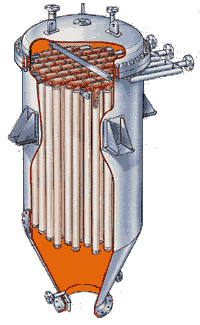
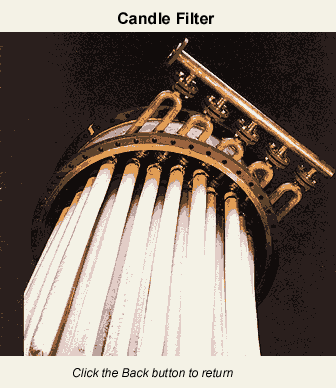
The Candle Filters are, as all pressure filters, operating on a batch cycle and may be seen in process lines handling titanium dioxide, flue gas, brine clarification, red mud, china clay, fine chemicals and many other applications that require efficient low moisture cake filtration or high degree of polishing.
Candle Filters are also used for thickening to produce a concentrated flowable slurry by partial removal of the liquid phase as filtrate. This mode of operation is possible since Candle Filters may operate on very short cycle times taking advantage of the high filtration rates whilst the cakes are still thin. One of the features of Candle Filters when used for thickening is their clear filtrate since gravity Thickeners, in analogy, produce overflows which always contain a certain amount of fine suspended solids.
|
Another feature of Candle Filters is the cylindrical
shape of the elements that retain the formed cake. This shape, opposed to
Plate,
Leaf or
Filterpresses, increases the
filtration area as cakes grow thicker and compensate to some extent to the
decrease in filtration rates. Candle Filters are very well suited for handling flammable, toxic and corrosive materials since they are autoclaved and designed for hazardous environments when high pressure and safe operation are required. Likewise, they may be readily jacketed for applications whenever hot or cold temperatures are to be preserved. These features are not possible on Filterpresses which require the opening of plates to the atmosphere by one to allow cake discharge at the end of each cycle. Candle Filters are available in all sizes and the larger types may have an area of 200 m2 and contain 250 or more filtering elements installed in a 2.5 to 3.0 meter diameter vessels. The operating pressure range is quite wide but most of the Candle Filters operate at a pressure of 6 bars. |
The Candle Filter consists of three major components:
All these components may be constructed from exotic materials of construction and heated to meet the process requirements.
The Vessel
There are two types of vessel configuration:
|
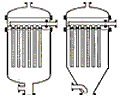 |
The feed to the filter is always positioned at the lower portion of the vessel to allow upflow of the incoming slurry. This is imperative for maintaining fast settling solids in a homogeneous suspension and thus ensure that uniform cakes are formed. An uneven cake thickness that tapers up interferes with the efficiency of cake washing and reduces the effective volume of the cake that accumulates on the filtering elements. To control the upflow velocity an overflow connection is positioned on the dished top and the selected pump must be sized to deliver a higher rate than required for the calculated material balance.
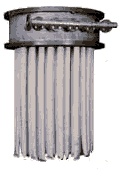
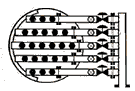 The filtrate outlet from each row of candles is connected to a horizontal header
and all headers deliver the filtrate through valves to a collecting manifold for
further processing. The arrangement of headers enables individual control
on the flow in each row of candles so that increasing flowrate per element during
cake formation, sequential cake discharge or backwashing may be used for flexibility
of operation. Likewise, incorporating a sight glass on each header enables the monitoring
of the quality of the filtrate so that torn cloths may be identified and the entire
row isolated. The headers are spaced with special inserts so that the distance between
the candles may be modified to accommodate cakes up to 50 mm thickness.
The filtrate outlet from each row of candles is connected to a horizontal header
and all headers deliver the filtrate through valves to a collecting manifold for
further processing. The arrangement of headers enables individual control
on the flow in each row of candles so that increasing flowrate per element during
cake formation, sequential cake discharge or backwashing may be used for flexibility
of operation. Likewise, incorporating a sight glass on each header enables the monitoring
of the quality of the filtrate so that torn cloths may be identified and the entire
row isolated. The headers are spaced with special inserts so that the distance between
the candles may be modified to accommodate cakes up to 50 mm thickness.
The Candles
The core serves for filtrate passage and to support the filter medium. The core may be a bundle of perforated tubes or ball shaped packing material that is contained in a coarse mesh screen sleeve. In the majority of applications the process requires to empty the elements from filtrate at the end of the filtration or washing cycle. This is achieved by inserting a pipe in the middle of the core to fully displace the filtrate during air or gas purging from the bottom of the element and upwards towards the header.
The selection of a suitable filter medium is perhaps one of the main problems confronting the process engineer and requires experience or a systematic trial and error program. Pressure leaf tests can provide some indication on the behavior of the cake to medium interface but long term effects such as gradual medium blinding cannot be established during testing.
The available types of filter medium are very diverse such as porous ceramics, sintered metal tubes, expanded sheets, woven mesh screens or synthetic filter cloths in sophisticated materials and weaves, mono and multifilament yarns, micron sizes and air permeabilities.
The Cake Discharge Mechanism
|
There are two methods to discharge the cake at the end of
the cycle:
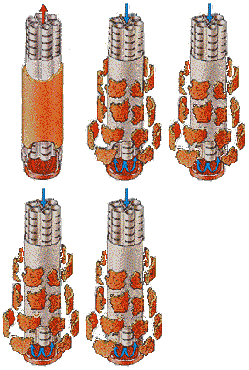
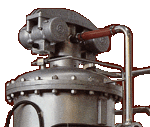
For cakes that discharge readily a snap blow from the backside of the medium is sufficient to release the cake but cakes that are difficult to discharge require a mechanism that assists release by vibrating the entire pack of candles. In this instance it is good practice to incorporate special headers with high impact sprays in the upper part of the vessel to clean the candles and dislodge entrained particles. |
The major difficulty in discharging arises when the clearance between the cake surfaces closes so in a recent innovation sensors are used to monitor the cake thickness and transmit a signal to turn off the slurry feed pump.
Candle Filters are best selected in the following instances:
They should be selected with care:
When the cake is thick and heavy and the pressure is not sufficient to hold it on the candle.
When coarse mesh screens are used the filtration step must be preceded with a precoat to retain cakes with fine particles. Precoating with a thin layer of diatomite or perlite is not a simple operation and should be avoided whenever possible.
Advantages
Disadvantages
The emptying of the vessel in between cake filtration, washing and drying requires close monitoring of the pressure inside the vessel to ensure that the cake holds on to the candles.
|
The precoating stage is done only in the following cases:
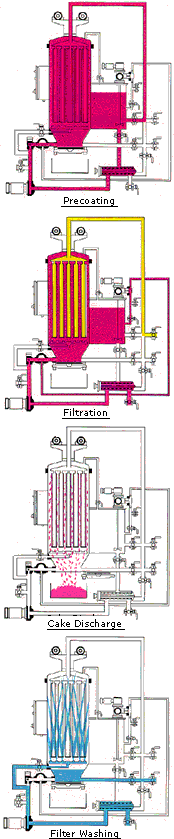
Filtration Once the precoating stage is completed the process slurry is pumped into the filter, the forming cake is retained on the candles and the filtrate flows to further processing. When the solids are fine and slow to filter a body-aid is added to the feed slurry in order to enhance cake permeability. However, it should be kept in mind that the addition of body-aid increases the solids concentration in the feed so it occupies additional volume between the candles and increases the amount of cake for disposal. Likewise, for all those applications when the cake is the product, precoat and filter-aid may not be used since they mix and discharge together with the cake. Please refer to the section on Pressure Filters for further details on precoating and the addition of body-aid. Heel Removal Once the filtration cycle is completed air or gas is blown into the vessel and the slurry heel that surrounds the candles is pushed and displaced downwards until it reaches the lowest part of the candle stack. At this point the remaining heel slurry is evacuated back to the feed tank by a special dip pipe that is located at the very bottom of the vessel so that the vessel is empty from slurry. Cake Drying The air then continues to pass through the cake until the captive moisture is reduced to a minimum and the cake is in practical terms considered to be dry. Cake Discharge At this point the air pressure is released, the cake outlet is opened and the candle stack is back blown or vibrated to discharge the cake. The cake outlet opening must be interlocked with a pressure sensor to avoid opening under pressure. On some filters the cloth or mesh screen may be backwashed with water after cake discharge to dislodge and remove any cake residue that adhered to the medium.
MaintenanceThe Candle Filter requires attention on a regular basis to safety devices and automation features that accompany modern filters. The space above the filter should have a hoisting device and sufficient headroom to lift each candle and move it horizontally to a location adjacent to the filter tank. It is recommended to have a special rig that will hold the candle for maintenance. Space must also be allocated for the cover which may be either hinged or removed. The major components that require attention are:
|
|