|
The separation of solids from a liquid by gravity sedimentation has traces to the early days of civilization. The normal practice at those times was to use jars or pits mainly for the clarification of extracted liquids such as wine or olive oil from contaminating insoluble matter. These batch processes required four separate steps:
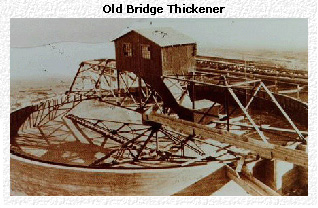
This cycle, depending on solid and liquid properties that effect settling rate, may require long detention times so often several vessels are incorporated in the layout to operate in sequential steps. The method of operating on a batch process is still practiced in small flow industries but its shortcomings are obvious so once the plants grew larger the need for continuous operation became inevitable. The trend in this direction started at the late 19th century when heavy duty applications such as iron ore taconites, hematite, coal, aluminum hydrate, copper pyrite, phosphates and other beneficiation processes have grown rapidly. The high time for thickeners was in the 60's when the metallurgical industries were booming and sizes of up to 150 m diameter were constructed. Such jumbo thickeners, when centrally driven, require for most demanding applications extra heavy duty drive heads some of which reach a continuous operating torque of 3.300.000 Nm.
|
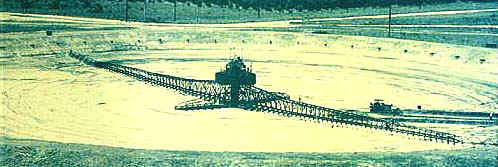
| 150 meter Column Type Thickener handling phosphate slimes |
|
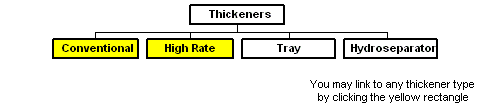
The various types of thickeners may be grouped as follows:
Thickeners are a major component in a plant layout and their selection may be critical for several reasons:
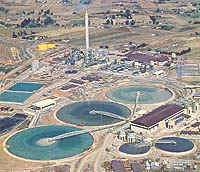
They occupy large spaces as may be seen from the aerial photograph of three large thickeners.
They are normally positioned far away from the center of the plant and owing to the large flows they are fed by gravity to save pumping. Therefore their position for a given hydraulic gradient may determine the elevation of the entire plant.
Rake driven thickeners for continuous operation can impose a substantial burden on capital investment.
Unlike many other types of equipment, thickeners have no stand-bys so if one goes out of commission it cannot be by-passed. Consequently, if this happens other thickeners have to take the extra load but if the plant incorporates just one thickener then the entire production line must stop.
To take a thickener out of commission for repairs inside the tank such as damaged blades, or rubber lining may take days since it requires to empty the tank, remove the underflow bed, refill it and find a suitable storage or disposal site for very large volumes of liquid.
In broad terms they are incorporated in flowsheets for the following purposes:
- statutory requirements for effluent quality.
- recycled overflow clarity for internal process requirements.
- reduction in loss of product to the overflow.
Hydroseparation in the upward direction to classify and remove a desired particle size fraction or solids of a different property by controlling the overflow rate. Hydroseparators are not discussed in this section.
Classification of Particle Subsidence and Equipment Selection
The basic rule for efficient phase separation is that the suspended particles settle in a laminar environment where the upward velocity of the liquid is lower than the settling velocity of the solid matter. To meet this requirement the relative settling characteristics of solids in a liquid are defined by three basic groups:
Class #1 – Independent Particle Subsidence
Slurries with a low solids contents that settle freely without interfering with their
neighboring particles leaving a clear supernatant. This class follows basically
the Stokes Law before reaching the point of entry to the compression zone.
Class #2 – Intermediate Particle Subsidence
Slurries with solids that settle with several zone boundaries of varying degrees of clarity
and mostly show no sharp interface. Such slurries are often flocculated to
enhance the capture of fines to speed-up settling.
Class #3 – Mass Particle Subsidence
Slurries with high solids content that may settle freely at the beginning but shortly
thereafter the particles enter hindrance that causes settling rate to decrease
as concentration increases due to compression. The solids in such slurries show a sharp interface
between the clear supernatant and the mass of settling solids.
There are also some in between classes but they are not discussed in this section.
The selection of equipment depends largely on test work for determining the class type. As a rough guideline Class #1 slurries may suit Lamella Settlers, Class #2 Clarifiers handling flocculated slurries and Class #3 Conventional Thickeners.