| Click
on the thumbnail to maximize the image |
Filterpresses were introduced at the turn of the century and have been around for many years mainly dewatering waste sludges. They were considered labor intensive machines hence they did not find much acceptance in the sophisticated and highly automated process industries. It was not until sometime in the 60's that this image has changed by the introduction of advanced mechanisms that were oriented towards obtaining low moisture cakes that discharge automatically and enable the washing of the cloth at the end of the filtration cycle.
|
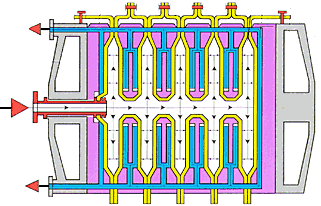
The head serves as a fixed end to which the feed and filtrate pipes are connected and the follower moves along the beams and presses the plates together during the filtration cycle by a hydraulic or mechanical mechanism. The plates have generally a centered feed port that passes through the entire length of the filterpress so that all the chambers of the plate pack are connected together. Likewise, four corner ports connect all the plates and collect the mother and wash filtrates in a "closed discharge" towards outlets that are located on the same side as the feed inlet. Some filterpresses have plates that are fitted with cocks at their lower side so that the filtrate flows in an "open discharge" to a trough and serve as "tell tales" on the condition of the filter cloth by the clarity of the filtrate that passes through each chamber. The disadvantage of this arrangement is that it cannot be used with filtrates that are toxic, flammable or volatile.
A typical flowscheme looks like this:
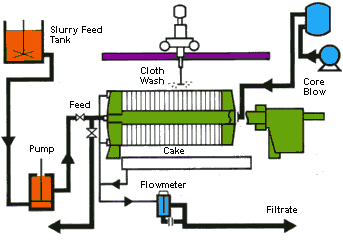
The present day Filterpresses, as mentioned previously, are equipped with features that enable fully automatic operation controlled by PLC's.
The main features are:
Shuttle shifters that separate the plates one by one for cake discharge at a rate of 5-6 seconds per plate. A special design of the shifting mechanism ensures that two adjacent plates are not pulled together due to sticky cakes as may be seen below:
Shakers that subject the plate to vibrations and assist in discharging the cake.
Cloth showers with movable manifolds and high impact jets for intensive cloth washing.
Often special measures are taken to ease cake discharge and enhance filtration.
The measures are:
Precoating the plates prior to introducing the feed is done only in the following cases:
When the contaminants are gelatinous and sticky it forms a barrier that avoids cloth blinding. Likewise the interface between the precoat and the cloth departs readily so the cake discharges leaving a clean cloth.
When a clear filtrate is required immediately after the filtration cycle commences otherwise recirculation must be employed until a clear filtrate is obtained.
Once the precoating stage is completed the process slurry is pumped into the filter, the forming cake is retained on the plates and the filtrate flows to further processing.
When the solids are fine and slow to filter a body-aid is added to the feed slurry in order to enhance cake permeability. However, it should be kept in mind that the addition of body-aid increases the solids concentration in the feed so it occupies additional volume between the plates and increases the amount of cake for disposal.
Likewise, for all those applications when the cake is the product, precoat and filter-aid may not be used since they mix and discharge together with the cake.
Please refer to the section on Pressure Filters for further details on precoating and the addition of body-aid.
The Plates
For many years filterpresses, named Plate and Frame, have used flush plates with
separate frames to contain the cake. These Plate and Frame Filterpresses had many
sealing surfaces which were the main cause for leakages so the introduction of Recessed
Plates has cut the number of surfaces in half and reduced the problem of drippings.
The development of Recessed Plates has gone hand in hand with advances in cloth
technology which enabled 3 dimensional stretching as opposed to Plate and Frame
where the cloth remains in one plain.
Present recess depths are 16, 20 and 25 mm so the corresponding cake thicknesses are 32, 40 and 50 mm at maximum filling. Filterpresses are built for operating pressures of 7, 10 and 15 bar for cake squeezing and the largest available plates are 2 by 2 meters so the hydraulic pressure system that holds the closing force of the plates is designed accordingly. Filterpress plates are available in various materials of construction such as cast iron, aluminum alloys, high-density polypropylene and PVDF. The major area of development, apart from automation, was in the design of the plates since thermoplastics have enabled new structural concepts which were not possible with metallic plates.
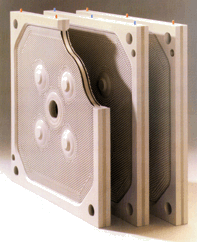
The special features are:
Lower plate weight has reduced the downtime for shuttle shifting during the cake discharge mode.
Effective filtration area has gone up since with the largest available plates of 2 by 2 meters, having a 20 mm recess and 150 chambers, the area is about 1000 m2 with a cake capacity of 20 m3.
The introduction of water, or air to a lesser extent, from the backside of flexible membranes reduces chamber volume and squeezes the cake yielding a further lowering of the moisture content. The fliterpress may be arranged as a mixed pack of flush and membrane plates, full flush or full membrane pack depending on the application.
Typical membrane plates are shown in the photo to the right.
Most plates are extruded in polypropylene which withstands temperatures of 80-85C. Operating at higher temperatures will warp the plates and leakage or even squirts can be dangerous at such high temperatures.
Filterpresses are best selected in the following instances:
When a very low moisture content is required for thermal cake drying or incineration.
When high filtrate clarity is required for polishing applications.
When good cake release assisted by squeezing is required.
When the cake is disposed as land fill for spreading with a bulldozer provided it is hard enough to carry its weight.
When large filtration areas are required in a limited space.
They should be selected with care:
When filtering saturated brines since the plates cool-off during cake discharge and require preheating prior to feeding the process slurry. For such brines autoclaved filters such as Horizontal Plates, Vertical Leaf or Candle Filters are better suited as they can be steam jacketed.
When there is a risk of environmental hazard from toxic, flammable or volatile cakes when the plates are opened for discharge at the end of each cycle. Again, the autoclaved filters are better suited.
When efficient washing is required since with a chamber filled with cake the wash water may not reach all its surface causing an uneven displacement. This, however, should present no problem when a gap is left between the formed cakes within a chamber so that the wash water is distributed evenly over the cake and reaches its entire surface.
The basic design of the following configurations may be viewed in both animations to the left:
Filterpress with conventional plates:
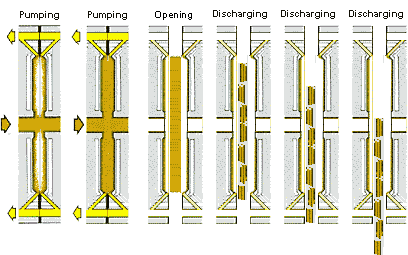
Slurry is pumped and fills the chambers at a high flow rate and low pressure which gradually builds-up as the cake gets thicker. The drip trays which are positioned below the filterpress for the collection of drippings closed.
When pressure reaches 6-7 bars wash water is pumped through the filter cake at a predetermined wash ratio to displace the adhering mother solution.
Air blowing is applied to reduce cake moisture.
The wet core that remains in the feed port is blown back with air for 20-30 seconds to ensure that the discharged cake is completely dry.
The drip trays open and are ready for cake discharge.
The hydraulic plate closing piston retracts together with the follower.
The shuttle shifter moves the plates one by one towards the follower and the cake discharges.
The drip trays close and are ready for the next cycle.
The shuttle shifter moves the plates back one by one towards the fixed header. When each plate parks the cloth is washed at 100 bar with a mechanism that lowers and lifts a pair of symmetrical manifolds with high impact nozzles.
Filterpress with membrane plates:
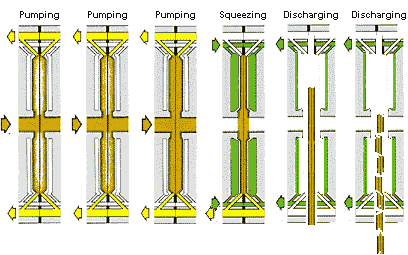
Slurry is pumped and fills the chambers at a high flow rate and low pressure which gradually builds-up as the cake gets thicker. The drip trays are closed.
The membranes, of empty chamber type plates, are pressed back to allow cake formation.
When pressure reaches 6-7 bars the cake is presqueezed for even distribution by pumping water to the backside of the membranes.
Wash water is pumped through the filter cake at a predetermined wash ratio to displace the adhering mother solution.
Air blowing is applied to reduce cake moisture.
More water is pumped to the backside of the membranes for final squeezing up to 15 bar to further reduce moisture.
The wet core that remains in the feed port is blown back with air at 6-7 bars for 20-30 seconds to ensure that the discharged cake is completely dry.
The drip trays open and are ready for cake discharge.
The hydraulic plate closing piston retracts together with the follower.
The shuttle shifter moves the plates one by one towards the follower and the cake discharges.
The drip trays close and are ready for the next cycle.
The shuttle shifter moves the plates back one by one towards the fixed header. When each plate parks the cloth is washed at 100 bar with a mechanism that lowers and lifts a pair of symmetrical manifolds with high impact nozzles.
Cake Disposal
During cake squeezing drippings are collected in a drip tray underneath the plate stack to avoid them from reaching the dry cake collection bin. The drip tray consists of two hinged horizontal doors that span along the filterpress with a slight angle to drain the drippings towards the head or the follower. When the filtration cycle is completed the doors open with a pneumatic or hydraulic system, the plate stack starts shuttle shifting and the cake falls one by one into the bin. When all the cake is in the bin the doors close and are ready for another cycle.
The cake in the bin is then trucked away or transported with a belt conveyor. With very large filterpresses a well formed cake may weigh 200-300 Kg per chamber and when it falls into a bin or onto a belt conveyor in one solid piece the impact is very high. Hence, special measures are required to break and de-lump the sole hard cake and, for belt conveyors, it is also recommended to increase the number of belt support rollers below the discharge chute at the point of impact.
| The clip below shows the operation of the drip pan: |
The filterpress by itself requires little maintenance however the automation features that accompany modern filterpresses should be checked regularly and with particular attention to safety devices such as:
The infra-red curtain that protects the operator during the closure of the plate pack should stop the hydraulic pump within 2 milliseconds.
The switch that warns when a loss of pressure in the hydraulic plate closing system detects leakage between the plates.
The filtrate flow meter microswitch that stops the slurry feed pump when the chambers are full.
The microswitch that is attached to the drip trays is interlocked so that the doors are fully open during cake discharge.
The pressure switch that permits squeezing of the membranes only when the plate pack is compressed with the hydraulic closing system.
The zippered bellows that protect the hydraulic piston against drippings should be checked for wear and tear.
The two manifolds that wash the cloth on both sides of the plate have high impact nozzles at a pressure of 100 bar. When some nozzles of one manifold are plugged the jet impact is uneven and the plates tend to swing.
The cloth must be checked for holes and the optional cocks on the filtrate port of each plate help in identifying damaged cloths.
The impregnated edges that surround the cloth and seal between adjacent plates should be checked for leakage.