Pressure Filters, with the exception of the Rotary Drum Pressure Filter, are semi-continuous type machines that enter a wash and cake discharge mode at the end of the filtration cycle. The filtration cycle may extend from 5-10 minutes on cake filtration applications and up to 8 or even more hours for the polishing of liquids. Since the operation is in batches, that are usually fed from and discharged to a continuous process, a surge tank is required upstream the filter and batch collection of cake downstream the filter. The collection of filtrate depends on the operating mode of the filter which can be constant flow rate, constant pressure or both with pressure rising and flow rate reducing as for a centrifugal pump.
Most Pressure Filters are batch operated but continuous filters are also available. However, owing to the difficulty in removing the cake they are mechanically complex and expensive so mainly applied in fine chemical processes where the added value to the product is high.
There are two constraining factors that determine the duration of the filtration cycle:
For cake filtration it is the volume available for cake build-up and once the volume is filled the cycle must terminate even if the permissible pressure was not reached.
For polishing, or when the solids are fast blinding, the cycle must terminate once the permissible pressure has been reached regardless of cake thickness.
The filtration rate is influenced, in broad terms, by the properties of the slurry. The trend is that the rate goes up with increased pressure, coarser particles, particle distribution with high uniformity, non-slimy or non-gelatinous solids, non-compressible cakes, lower liquid viscosity and higher temperatures.
Body-aid (sometimes also called filter-aid) and precoating are often mentioned in connection with pressure filtration and the difference in their application is:
Body aid is used when the slurry is low in solids content with fine and slimy particles that are difficult to filter. To enhance filtration coarse solids with large surface area are added to the slurry and serve as a body-aid that captures and traps in its interstices the slow filtering particles and produce a porous cake matrix. The amount added depends on the nature of the solids and varies from ½ for non-compressible and up to 5 times for gelatinous solids.
Precoating the plates with a 2-3 mm thick medium of a known permeability and its application requires skills since it takes-up effective cake volume, lengthens the cycle time and an over consumption can be quite costly.
Precoating prior to filtration serves two main purposes:
When the contaminants are gelatinous and sticky it forms a barrier that avoids cloth blinding. Likewise the interface between the precoat and the cloth parts readily so the cake discharges leaving a clean cloth.
When a clear filtrate is required immediately after the filtration cycle commences otherwise recirculation must be employed until a clear filtrate is obtained.
The following materials serve as body-aid or are used to form a precoat:
Diatomaceous Earth (also called Diatomite) consisting of silicaceous skeletal remains of tiny aquatic unicellular plants.
Perlite consisting of glassy crushed and heat-expanded rock from volcanic origin.
Cellulose consisting of fibrous light weight and ashless paper like medium.
Special groundwood is becoming popular in recent years since it is combustible and reduces the high cost of disposal. There are nowadays manufacturers that grind, wash and classify special timber to permeabilities which can suit a wide range of applications.
All the material above are produced to specification in a controlled process. However, for applications that do not require high quality any other solid that is readily available and has similar properties may be used as body-aid.
The Types of Pressure Filters
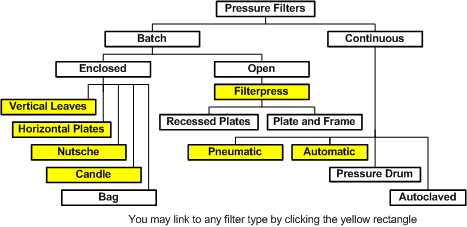
Pressure filters may be grouped as shown in the tree to the right.
The sizes for standard equipment are as follows:
The block diagram for a typical filter station and its components may
look like this: 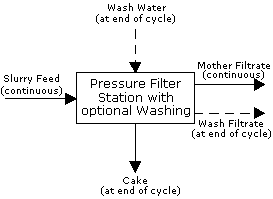
The advantages and disadvantages of pressure filtration compared to other separation methods are:
Advantages
Cakes are obtained with very low moisture content.
Cakes may be disposed and flattened in layers provided they are not thixotropic and sufficiently stable to support a tractor.
Intensive soluble recovery or removal of contaminants from the cake may be achieved.
Clean filtrates may be produced by recirculating the filtrate for 1-2 minutes or by precoating if a clear filtrate is required right from the start.
Solutions may be polished to a high degree of clarity.
Except for Filterpresses a gas tight construction may be provided.
Except for Filterpresses it is possible to jacket the tanks with steam if heat preservation is required. This is of particular importance for saturated brines.
The filter bodies and internals may be constructed from a wide variety of alloys including synthetic materials for filterpresses.
Pressure Filters are available in a wide level of automation from labor intensive operator controlled up to fully automatic machines.
Disadvantages
Cloth washing is difficult and if the solids are sticky a 3 mm precoat from diatomite or perlite is required. This adds another step prior to filtration and if not done carefully and a too thin precoat is formed it may leave areas with exposed cloth which will blind rapidly. Conversely, if a too thick precoat is formed since the operator seeks to be on the safe side, such a precoat consumes effective cake volume.
The operator can hardly see the forming cake and is unable to carry out an inspection while the filter is in operation.
The internals are difficult to clean and this may be a problem with food grade applications.